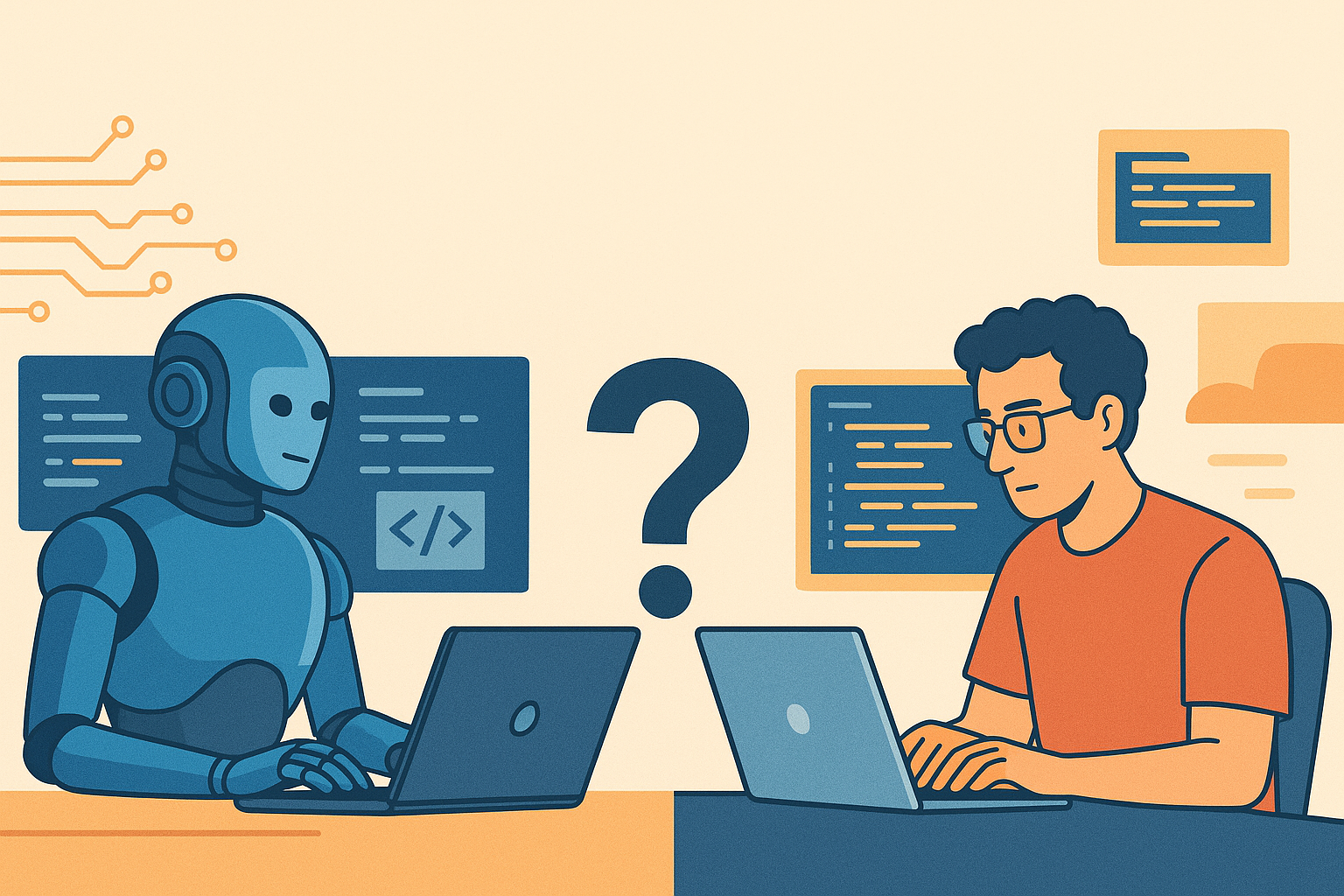
As artificial intelligence continues to evolve, the question lingers: will AI replace programmers? In a world increasingly driven by automation, the landscape of coding is undergoing a seismic shift. While AI has already begun to augment the work of developers, enhancing productivity and streamlining processes, the role of the programmer remains crucial. This article delves into the intricate relationship between AI and coding, exploring both the fears and the possibilities that emerge as technology advances. Can machines truly replicate human creativity and problem-solving skills? Or does the future lie in a collaborative workspace where AI and programmers work hand-in-hand? Join us as we unravel the complexities of this dynamic field, offering insights into what the future may hold for both aspiring coders and seasoned developers alike.
The Evolution of AI in Software Development
Artificial Intelligence (AI) has made significant strides over the past few decades, evolving from a distant concept to a transformative force within the realm of software development. The journey began with rudimentary algorithms that could perform simple, rule-based tasks. However, as technology advanced, so did the capabilities of AI. Early iterations of AI tools, such as those for code autocompletion and syntax checking, laid the groundwork for more sophisticated systems. These early tools were designed to assist developers by reducing the time spent on mundane tasks, thereby allowing them to focus on more complex problem-solving activities.
The 2010s marked a pivotal decade in the evolution of AI in software development. Machine learning, a subset of AI, became more prevalent, allowing systems to learn from vast amounts of data and improve over time. This period saw the rise of neural networks and deep learning, which further enhanced the capabilities of AI. Tools like TensorFlow and PyTorch emerged, enabling developers to build and train their machine learning models with unprecedented ease. These advancements not only streamlined the development process but also opened up new possibilities for creating intelligent applications.
Today, AI is deeply integrated into the software development lifecycle. From intelligent code editors that predict and suggest code snippets to automated testing frameworks that ensure software reliability, AI has permeated every aspect of coding. Moreover, the advent of natural language processing (NLP) has enabled AI systems to understand and generate human-like code, blurring the lines between human and machine capabilities. As AI continues to evolve, it is poised to redefine the landscape of software development, raising questions about the future roles of programmers and the nature of coding itself.
Current AI Tools and Their Impact on Coding
The current landscape of AI tools in software development is both diverse and dynamic, offering a range of functionalities that enhance the coding process. One of the most prominent tools is GitHub Copilot, an AI-powered code completion assistant developed by OpenAI. Copilot leverages the power of OpenAI’s Codex model to provide context-aware code suggestions, effectively acting as a pair programmer. By analyzing the code in real-time, Copilot can suggest entire functions, reducing the amount of boilerplate code developers need to write and significantly speeding up the development process.
Another notable AI tool is DeepCode, which focuses on code quality and security. DeepCode uses machine learning to analyze codebases and identify potential vulnerabilities and bugs. By scanning millions of lines of code from various open-source projects, DeepCode has developed a comprehensive understanding of common coding errors and best practices. This allows it to provide real-time feedback to developers, ensuring that their code is not only functional but also secure and maintainable. Tools like DeepCode are invaluable in the current era of cybersecurity threats, where even a small vulnerability can have far-reaching consequences.
AI-driven testing frameworks, such as Test.ai, are also making waves in the software development community. Test.ai automates the process of writing and executing test cases, leveraging AI to understand the application’s behavior and predict potential failure points. By continuously learning from the application’s interactions, Test.ai can adapt to changes in the codebase and ensure that new features do not introduce regressions. This level of automation not only improves the efficiency of the testing process but also enhances the overall quality of the software, providing developers with greater confidence in their code.
Advantages of AI-Assisted Programming
The integration of AI into programming offers numerous advantages, one of the most significant being increased productivity. By automating repetitive and mundane tasks, AI allows developers to focus on more creative and complex aspects of software development. For instance, AI-powered code completion tools can predict and fill in entire lines of code, reducing the time spent on writing boilerplate code. This not only accelerates the development process but also minimizes the likelihood of human error, leading to more efficient and reliable code.
Another advantage of AI-assisted programming is enhanced code quality. AI tools can analyze large codebases to identify patterns and detect potential issues that may not be immediately apparent to human developers. By providing real-time feedback on coding practices, AI can help developers adhere to best practices and avoid common pitfalls. This is particularly valuable in the context of security, where even minor vulnerabilities can have significant consequences. AI-driven code analysis tools can identify and suggest fixes for security flaws, ensuring that the software is robust and secure.
AI also facilitates better collaboration among development teams. With AI tools providing consistent and objective feedback, developers can maintain a uniform coding standard across the team. This is especially important in large projects where multiple developers are working on different parts of the codebase. AI can also assist in code reviews, highlighting areas that need attention and suggesting improvements. By streamlining the code review process, AI enables teams to work more cohesively and deliver high-quality software in a timely manner.
Limitations of AI in Software Development
Despite its many advantages, AI in software development is not without its limitations. One of the primary challenges is the lack of contextual understanding. While AI tools can analyze code and provide suggestions, they often lack the deeper understanding of the project’s overall goals and requirements. This can lead to recommendations that are technically correct but not aligned with the project’s objectives. For example, an AI tool might suggest an optimization that improves performance but compromises readability or maintainability, which might not be desirable in all cases.
Another limitation is the dependency on large datasets for training. AI models require vast amounts of data to learn and make accurate predictions. This can be a significant barrier for smaller projects or organizations that do not have access to extensive code repositories. Furthermore, the quality of the AI’s output is heavily dependent on the quality of the training data. If the training data contains biases or inaccuracies, the AI tool is likely to replicate those issues in its recommendations. This can lead to suboptimal code and perpetuate existing problems within the software.
Ethical considerations also pose a challenge to the widespread adoption of AI in coding. The use of AI tools raises questions about accountability and transparency. If an AI-generated code snippet introduces a bug or vulnerability, it can be difficult to determine who is responsible for the error—the developer or the AI tool. Additionally, the proprietary nature of many AI models means that their inner workings are often opaque, making it challenging to understand how decisions are made. This lack of transparency can be problematic, particularly in regulated industries where accountability and compliance are critical.
Will AI Replace Programmers? Exploring the Future of Coding in an Automated World
As artificial intelligence continues to evolve, the question lingers: will AI replace programmers? In a world increasingly driven by automation, the landscape of coding is undergoing a seismic shift. While AI has already begun to augment the work of developers, enhancing productivity and streamlining processes, the role of the programmer remains crucial. This article delves into the intricate relationship between AI and coding, exploring both the fears and the possibilities that emerge as technology advances. Can machines truly replicate human creativity and problem-solving skills? Or does the future lie in a collaborative workspace where AI and programmers work hand-in-hand? Join us as we unravel the complexities of this dynamic field, offering insights into what the future may hold for both aspiring coders and seasoned developers alike.
The Evolution of AI in Software Development
<sub>Photo by Tumisu on Pixabay</sub>
Artificial Intelligence (AI) has made significant strides over the past few decades, evolving from a distant concept to a transformative force within the realm of software development. The journey began with rudimentary algorithms that could perform simple, rule-based tasks. However, as technology advanced, so did the capabilities of AI. Early iterations of AI tools, such as those for code autocompletion and syntax checking, laid the groundwork for more sophisticated systems. These early tools were designed to assist developers by reducing the time spent on mundane tasks, thereby allowing them to focus on more complex problem-solving activities.
The 2010s marked a pivotal decade in the evolution of AI in software development. Machine learning, a subset of AI, became more prevalent, allowing systems to learn from vast amounts of data and improve over time. This period saw the rise of neural networks and deep learning, which further enhanced the capabilities of AI. Tools like TensorFlow and PyTorch emerged, enabling developers to build and train their machine learning models with unprecedented ease. These advancements not only streamlined the development process but also opened up new possibilities for creating intelligent applications.
Today, AI is deeply integrated into the software development lifecycle. From intelligent code editors that predict and suggest code snippets to automated testing frameworks that ensure software reliability, AI has permeated every aspect of coding. Moreover, the advent of natural language processing (NLP) has enabled AI systems to understand and generate human-like code, blurring the lines between human and machine capabilities. As AI continues to evolve, it is poised to redefine the landscape of software development, raising questions about the future roles of programmers and the nature of coding itself.
Current AI Tools and Their Impact on Coding
The current landscape of AI tools in software development is both diverse and dynamic, offering a range of functionalities that enhance the coding process. One of the most prominent tools is GitHub Copilot, an AI-powered code completion assistant developed by OpenAI. Copilot leverages the power of OpenAI’s Codex model to provide context-aware code suggestions, effectively acting as a pair programmer. By analyzing the code in real-time, Copilot can suggest entire functions, reducing the amount of boilerplate code developers need to write and significantly speeding up the development process.
Another notable AI tool is DeepCode, which focuses on code quality and security. DeepCode uses machine learning to analyze codebases and identify potential vulnerabilities and bugs. By scanning millions of lines of code from various open-source projects, DeepCode has developed a comprehensive understanding of common coding errors and best practices. This allows it to provide real-time feedback to developers, ensuring that their code is not only functional but also secure and maintainable. Tools like DeepCode are invaluable in the current era of cybersecurity threats, where even a small vulnerability can have far-reaching consequences.
AI-driven testing frameworks, such as Test.ai, are also making waves in the software development community. Test.ai automates the process of writing and executing test cases, leveraging AI to understand the application’s behavior and predict potential failure points. By continuously learning from the application’s interactions, Test.ai can adapt to changes in the codebase and ensure that new features do not introduce regressions. This level of automation not only improves the efficiency of the testing process but also enhances the overall quality of the software, providing developers with greater confidence in their code.
Advantages of AI-Assisted Programming
The integration of AI into programming offers numerous advantages, one of the most significant being increased productivity. By automating repetitive and mundane tasks, AI allows developers to focus on more creative and complex aspects of software development. For instance, AI-powered code completion tools can predict and fill in entire lines of code, reducing the time spent on writing boilerplate code. This not only accelerates the development process but also minimizes the likelihood of human error, leading to more efficient and reliable code.
Another advantage of AI-assisted programming is enhanced code quality. AI tools can analyze large codebases to identify patterns and detect potential issues that may not be immediately apparent to human developers. By providing real-time feedback on coding practices, AI can help developers adhere to best practices and avoid common pitfalls. This is particularly valuable in the context of security, where even minor vulnerabilities can have significant consequences. AI-driven code analysis tools can identify and suggest fixes for security flaws, ensuring that the software is robust and secure.
AI also facilitates better collaboration among development teams. With AI tools providing consistent and objective feedback, developers can maintain a uniform coding standard across the team. This is especially important in large projects where multiple developers are working on different parts of the codebase. AI can also assist in code reviews, highlighting areas that need attention and suggesting improvements. By streamlining the code review process, AI enables teams to work more cohesively and deliver high-quality software in a timely manner.
Limitations of AI in Software Development
Despite its many advantages, AI in software development is not without its limitations. One of the primary challenges is the lack of contextual understanding. While AI tools can analyze code and provide suggestions, they often lack the deeper understanding of the project’s overall goals and requirements. This can lead to recommendations that are technically correct but not aligned with the project’s objectives. For example, an AI tool might suggest an optimization that improves performance but compromises readability or maintainability, which might not be desirable in all cases.
Another limitation is the dependency on large datasets for training. AI models require vast amounts of data to learn and make accurate predictions. This can be a significant barrier for smaller projects or organizations that do not have access to extensive code repositories. Furthermore, the quality of the AI’s output is heavily dependent on the quality of the training data. If the training data contains biases or inaccuracies, the AI tool is likely to replicate those issues in its recommendations. This can lead to suboptimal code and perpetuate existing problems within the software.
Ethical considerations also pose a challenge to the widespread adoption of AI in coding. The use of AI tools raises questions about accountability and transparency. If an AI-generated code snippet introduces a bug or vulnerability, it can be difficult to determine who is responsible for the error—the developer or the AI tool. Additionally, the proprietary nature of many AI models means that their inner workings are often opaque, making it challenging to understand how decisions are made. This lack of transparency can be problematic, particularly in regulated industries where accountability and compliance are critical.
The Role of Programmers in an AI-Driven World
In an AI-driven world, the role of programmers is evolving rather than diminishing. While AI can automate many aspects of coding, human programmers remain essential for tasks that require creativity, critical thinking, and domain-specific knowledge. AI tools are designed to assist and augment the work of developers, not to replace them. Programmers are needed to provide the context and understanding that AI lacks, ensuring that the code aligns with the project’s goals and requirements. They are also responsible for making high-level architectural decisions and navigating the complexities of software design.
Moreover, programmers play a crucial role in training and fine-tuning AI models. The effectiveness of AI tools is heavily dependent on the quality of the training data and the parameters used to train the models. Programmers with expertise in machine learning and data science are needed to curate datasets, select appropriate algorithms, and adjust parameters to optimize the performance of AI tools. This collaborative relationship between programmers and AI is essential for creating intelligent systems that are both effective and reliable.
The ethical and accountability aspects of AI also fall within the purview of programmers. Developers must ensure that AI tools are used responsibly and transparently, adhering to ethical guidelines and industry standards. This involves not only understanding the limitations and potential biases of AI models but also implementing safeguards to mitigate risks. Programmers are responsible for auditing AI-generated code, verifying its correctness, and ensuring that it meets the required standards. In this sense, the role of the programmer is evolving to encompass a broader set of responsibilities that extend beyond traditional coding tasks.
Skills Programmers Need to Thrive Alongside AI
As the landscape of software development evolves, programmers need to acquire new skills to thrive alongside AI. One of the most critical skills is proficiency in machine learning and data science. Understanding the fundamentals of machine learning algorithms, data preprocessing, and model evaluation is essential for working effectively with AI tools. This knowledge enables programmers to fine-tune AI models, interpret their outputs, and make informed decisions about how to integrate AI into the development process. Familiarity with frameworks such as TensorFlow, PyTorch, and scikit-learn is also valuable for implementing and experimenting with machine learning solutions.
Another important skill is the ability to work with large datasets. AI models rely on vast amounts of data for training and validation, and programmers need to be adept at handling, cleaning, and preprocessing this data. Knowledge of database management, data warehousing, and data visualization tools can be beneficial in managing and analyzing large datasets. Additionally, proficiency in programming languages commonly used in data science, such as Python and R, is crucial for developing and deploying AI models.
Soft skills are equally important in an AI-driven world. Effective communication and collaboration are essential for working in interdisciplinary teams that include data scientists, machine learning engineers, and domain experts. Programmers need to be able to articulate their ideas, explain technical concepts to non-technical stakeholders, and work collaboratively to achieve common goals. Critical thinking and problem-solving skills are also vital for navigating the complexities of AI and making informed decisions about its application in software development.
Case Studies: AI Success Stories in Coding
Several case studies highlight the successful integration of AI in coding, showcasing the transformative potential of this technology. One notable example is the use of AI by Microsoft in its Visual Studio IntelliCode. IntelliCode leverages machine learning to provide code recommendations based on best practices from thousands of open-source projects. By analyzing patterns in the code, IntelliCode can suggest context-aware code completions, refactorings, and style improvements. This has significantly enhanced developer productivity and code quality, demonstrating the value of AI in augmenting the coding process.
Another success story comes from the financial industry, where AI has been used to develop high-frequency trading algorithms. Companies like Goldman Sachs have employed AI to analyze vast amounts of market data, identify trading patterns, and execute trades at lightning speed. These AI-driven algorithms have outperformed traditional trading strategies, generating significant profits while minimizing risks. The success of AI in this domain underscores its potential to handle complex, data-intensive tasks that require rapid decision-making.
In the realm of cybersecurity, AI has proven to be a game-changer. Darktrace, a cybersecurity firm, uses AI to detect and respond to threats in real-time. By continuously monitoring network traffic and analyzing patterns of behavior, Darktrace’s AI can identify anomalies that may indicate a security breach. This proactive approach allows organizations to respond to threats before they can cause significant damage. The success of Darktrace highlights the potential of AI to enhance security and resilience in an increasingly digital world.
Future Trends: What’s Next for AI and Programmers?
The future of AI and programming is filled with exciting possibilities, driven by ongoing advancements in technology. One emerging trend is the development of AI that can understand and generate code in multiple programming languages. As AI models become more sophisticated, they will be able to work across different languages and frameworks, providing even greater flexibility and support for developers. This will enable programmers to leverage AI tools regardless of the technology stack they are using, fostering a more inclusive and collaborative development environment.
Another trend is the rise of AI-driven development platforms that automate the entire software development lifecycle. These platforms, often referred to as “no-code” or “low-code” solutions, allow users to build applications with minimal manual coding. By leveraging AI to handle the underlying code generation, these platforms enable users to focus on designing and configuring their applications. While these tools are primarily aimed at non-developers, they also have the potential to streamline the workflow for professional developers, allowing them to build and deploy applications more rapidly.
The integration of AI with other emerging technologies, such as the Internet of Things (IoT) and blockchain, is also set to shape the future of programming. AI can enhance the capabilities of IoT devices by enabling them to analyze data and make intelligent decisions in real-time. Similarly, AI can be used to improve the efficiency and security of blockchain networks, providing new opportunities for innovation. As these technologies converge, they will create new paradigms for software development, requiring programmers to adapt and expand their skill sets to stay relevant.
Conclusion: Embracing Change in the Coding Landscape
As we navigate the evolving landscape of software development, it is clear that AI will play an increasingly prominent role. While the question of whether AI will replace programmers remains complex, it is evident that the future lies in a collaborative workspace where AI and developers work hand-in-hand. AI has the potential to augment the capabilities of programmers, enhancing productivity, code quality, and security. However, human creativity, critical thinking, and domain-specific knowledge remain irreplaceable, ensuring that programmers will continue to play a vital role in the development process.
To thrive in this AI-driven world, programmers must embrace change and continuously adapt their skills. Proficiency in machine learning, data science, and data management will be essential for leveraging AI tools effectively. Soft skills, such as communication and collaboration, will also be crucial for working in interdisciplinary teams and navigating the complexities of AI. By cultivating these skills and staying abreast of emerging trends, programmers can position themselves at the forefront of innovation, driving the next wave of technological advancement.
In conclusion, the future of coding in an automated world is one of collaboration and co-evolution. AI and programmers have the potential to achieve remarkable feats when working together, pushing the boundaries of what is possible in software development. As we embrace this new era, it is essential to recognize the strengths and limitations of both AI and human intelligence, leveraging their unique capabilities to create a more efficient, secure, and innovative coding landscape. The journey ahead is filled with opportunities and challenges, and those who are willing to adapt and learn will be well-positioned to shape the future of coding in an AI-driven world.